
New on the ATLAS Blog
In their new contribution, "Educating Girls, Reforming Society: An Armeno-Turkish Treatise from Ayntab and Ottoman Debates on Female Education in the late 19th Century," Hülya Çelik and Ani Sargsyan examine Mary
G. Hollister’s Armeno-Turkish work Kızların Talim u Terbiyesi (The Education and Upbringing of Girls), published in Istanbul in 1880. Written in Antep, the treatise presents a comprehensive programme for
female education, linking questions of upbringing and schooling to contemporary debates on family, religion, social progress, and reform. It also illustrates how such debates circulated across linguistic,confessional, and regional boundaries in the late Ottoman Empire.
Read the full article:
https://atlas.univie.ac.at/?p=603

ViCAS Senior Fellowship 2026/27
We are pleased to announce that Edhem Eldem will join the Vienna Centre for Advanced Studies (ViCAS) as Senior Fellow from 1 October 2026 till 30 June 2027.
During his fellowship, Edhem Eldem will work on a monograph exploring archaeology, museology, and heritage in the Ottoman Empire during the long nineteenth century. Challenging both Eurocentric and nationalist narratives, the project offers a critical, source-based reassessment of how heritage was negotiated between local and global actors in an age of imperial expansion and modernisation.
ViCAS received a total of 1,729 applications, comprising 1,038 for the Early/mid-Career Fellowship and 691 for the Senior Fellowship. The inaugural 2026–2027 cohort comprises 9 mid-career Fellows and 10 Senior Fellows.
New Tenure-Track-professorship

© Grigor Boykov
New Tenure-Track-professorship
Congratulations to Grigor Boykov who was awarded the Tenure-Track-professorship for History of the Ottoman Balkans at the Faculty of Historical and Cultural Studies!
Understanding how power and governance work remains one of the central challenges of modern societies. Historical experience shows that political systems rarely function through centralized authority alone. More often they depend on negotiation, cooperation, and competition among a wide range of actors. Focusing on the Ottoman Empire and the Balkans, Grigor Boykov's research explores how political power was organized, negotiated, and exercised within a highly complex imperial society that gave rise to several modern nation-states. By combining traditional archival scholarship with digital and spatial approaches, he aims to highlight the importance of local elites in shaping imperial institutions and systems of governance, thereby contributing to broader debates about political authority, regional identities, and the ways in which diverse societies are integrated into larger political frameworks. Further information can be found at – www.ottomancore.org
For details, see: https://www.univie.ac.at/en/news/new-professorships/details/boykov-grigor-1
Workshop, Vienna, July 2-3, 2026

Workshop, Vienna, July 2-3, 2026
OttomanCORE Kick-off Workshop: Conceptual, Spatial, and Actor-Centered Perspectives on Ottoman Governance
Date: 2–3 July 2026 (Thu–Fri)
Venue: University of Vienna, Lecture Hall, Department for East European History (IOG), Spitalgasse 2, Hof 3, Eingang 3.2 (Campus)
Conveners: Grigor Boykov and Mariya Kiprovska
This workshop is organized within the framework of the ERC-2024-CoG 'OttomanCORE' funded by European Union's Horizon Europe research and innovation programme under grant agreement No 101170435.
What constitutes governance in an imperial context, and how might it be analyzed beyond the prism of centralized state power? Broadly understood as the exercise of control over resources, territory, and population, governance entails the infrastructural capacities to accumulate, regulate, communicate and redistribute. Yet, in the Ottoman case, much like in other imperial contexts, this capacity has often been associated almost exclusively with the centralizing authority of the imperial household and its bureaucratic apparatus. The workshop will revisit Ottoman governance as a dynamic and negotiated field of interaction among diverse actors — imperial, regional, and local — whose overlapping interests and spheres of influence shaped the empire's capacity to rule. By emphasizing spatial and social foundations of authority, we aim to explore how regional elites, intermediaries, and communities contributed to the making of imperial order. A further aim is to refine the analytical vocabulary through which these processes are described.
For further information (including the programme) see: https://www.ottomancore.org/_files/ugd/f5b16d_b9565f94810b44eda96870d435d13a75.pdf
Reading the City: Epigraphy and Space in Istanbul in Ancient, Byzantine, and Ottoman Times, Summer Academy, Orient-Institut Istanbul, September 21–27, 2026
Coorganized by the Orient-Institut Istanbul, the Center for the Study of Manuscript Cultures Hamburg and the Institute for Medieval Research of the Austrian Academy of Sciences.
https://oiist.org/call-for-applications-reading-the-city/
Instructors
Dr. Christiane Czygan, Orient-Institut Istanbul
Prof. Dr. Kaja Harter-Uibopuu, CSMC Hamburg
Dr. Krystina Kubina, University of Vienna
Prof. Dr. Christoph K. Neumann, Orient-Institut Istanbul
PD Dr. Andreas Rhoby, Austrian Academy of Sciences, Vienna
Prof. Dr. Mustafa Hamdi Sayar, Istanbul University
Assist. Prof. Dr. Gülşah Taşkın, Boğaziçi University
This interdisciplinary Summer Academy invites advanced MA students, doctoral candidates, and early postdoctoral researchers to explore the role of epigraphy in shaping Istanbul’s urban, sacred, and imperial spaces across antiquity, the Byzantine era, and the Ottoman period.
Inscriptions constitute not only documents but also monuments or artefacts situated in specific spatial settings, where they actively mark and articulate thresholds. This conviction forms the basis for all further inquiries of the academy. Building on this perspective, the program will examine how epigraphic texts delineate transitions between sacred and profane, interior and exterior, imperial and civic. Inscriptions on palatial gates and entrances to religious buildings, on convent walls, and along the Bosporus shoreline in Üsküdar (a major point of passage between Anatolia and Istanbul) will serve as case studies.
Sessions will combine seminar discussions with excursions in the city, allowing participants to engage with inscriptions both in a classroom setting and in situ. Student presentations will alternate with contributions by the faculty, fostering an interactive and dialogical format. Emphasis will be placed not only on decipherment but also on the physical setting, visibility, and performative dimensions of each inscription. Broader questions and comparative approaches are welcome.
Working knowledge of at least one epigraphic language (Ancient Greek, Latin, Arabic, Ottoman Turkish, etc.) is recommended.
Costs for accommodation will be supported. Lunch as well as two group dinners will be covered.
Application deadline: January 3, 2026, notifications will be sent by January 31, 2026
Please upload application with your motivation letter, CV, and a short letter of reference each as a separate PDF file using the link here.
Conference, Vienna, November 16-19, 2026
Conference, Vienna, November 16-19, 2026
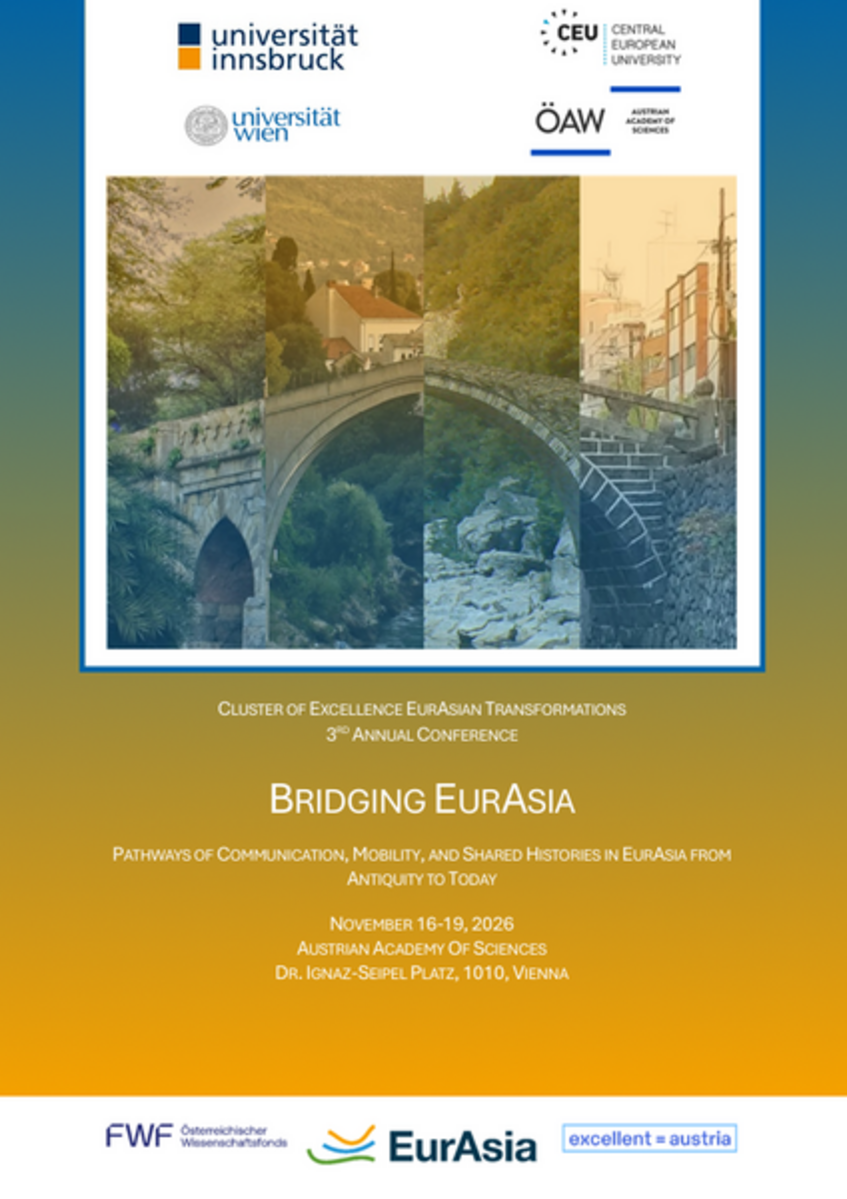
Cluster of Excellence EurAsian Transformations 3rd Annual Conference
Venue: Austrian Academy of Sciences
Organizing committee: Yavuz Köse (University of Vienna), Melanie Malzahn (University of Vienna), Nina Mirnig (University of Vienna), Mariya Kiprovska (University of Vienna), Claudia Rapp (Austrian Academy of Sciences), Jim Rheingans (University of Vienna), Robert Rollinger (University of Innsbruck), Juliane Schiel (University of Vienna)
The conference aims to overcome entrenched disciplinary silos by integrating insights into history, archaeology, linguistics, anthropology, philology, art history, environmental studies, and digital humanities. By encouraging scholars at all career stages to work across boundaries, it seeks to cultivate collaborative and hybrid scholarly identities, fostering research cultures in which complex questions can be addressed through shared methodologies and interpretive frameworks. Building on this vision, the conference promotes a paradigm shift towards globally oriented and genuinely integrative research methodologies. It seeks to combine perspectives from diverse disciplines to analyze not only cross-regional connections but also the complex causal relationships and feedback loops between local specificities and broader Eurasian dynamics. Particular emphasis is placed on supporting early-career scholars in cultivating a “hybrid” intellectual identity from the outset of their careers — encouraging them to think beyond single-discipline boundaries, to formulate questions that demand multi-faceted answers, and to engage actively with colleagues from different academic and cultural backgrounds.